

The Four O'Clock Cookie Tin, and the Cup a Seamstress Set Beside It
A retired town clerk starts a journal of her own afternoons, and a friend from Kerala brings a small box of leaf tea. The label, the research and the return terms, recorded line by line.

First, the people: Marjorie Pell is a pen name. Saroja, the library booth and the town of Haddon Mills are composites, the way small-town columns have always been written.
Everything about the tea itself, its label, its price, its brewing directions and its return terms comes from the seller's own pages and box panels, read on October 25, 2026.

At four o'clock every afternoon, the kitchen clock in my house makes a small sound, a click more than a chime, as the minute hand climbs past the twelve.
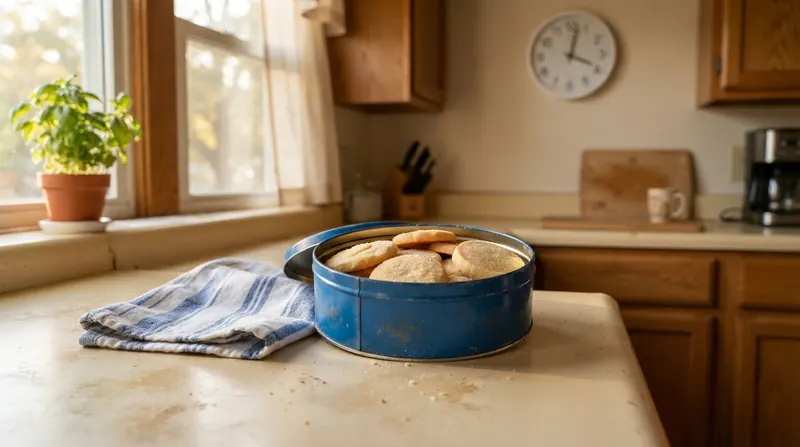
For about six years, that click was the sound of the cookie tin opening.
It is a round blue tin, the kind that used to hold Danish butter cookies and now holds whatever the grocery has on the bottom shelf. My late husband Lowell bought the first one in 1994.
I did not count what came out of it. That is the strange part, because counting is the one thing I have done well my entire life.
For thirty-one years I was the clerk of Haddon Mills, Ohio, a town of 4,100 people, two traffic lights and a council that met on the first and third Tuesday of every month.
I kept the minute book. Every motion, every second, every vote, every "let the record show," written by hand and then typed, and then signed, and then stamped.
So it is a little embarrassing to admit that the one book I never kept was the book of my own afternoons.
This is the story of how I started keeping it, what went into the cup that now sits where the tin used to sit, and what I learned reading that cup's box the way I used to read a zoning variance.
I will tell you now what I told the council every time a salesman came to a meeting: nothing in this journal is a promise, and everything in it can be checked.
Thirty-One Years of Writing Down What Other People Said
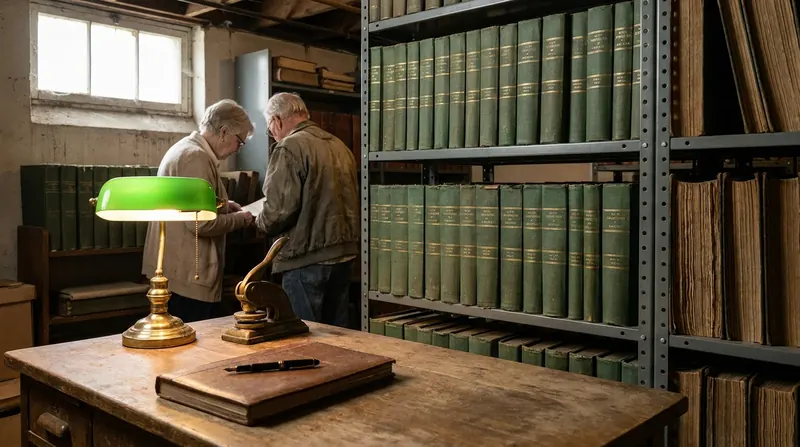
The minute books of Haddon Mills live on a steel shelf in the basement of the town hall, bound in green buckram with the years stamped in gold on the spines.
Thirty-one of those spines are mine. I could find you the 1998 vote on the water tower in under a minute, with my eyes closed, by the feel of the cloth.
A town clerk learns a particular discipline. You do not write down what you think happened.
You write down what happened.
If a councilman says the new pump will "practically pay for itself," the minutes say: "Mr. Dorsey stated his view that the pump would reduce costs."
If a resident says the traffic on Mill Street is "a death trap," the minutes say: "Mrs. Ochs expressed concern regarding traffic on Mill Street."
You strip out the adjectives and you keep the facts. You record who said it, and when, and you let the reader decide what it means.
I used a fountain pen for the first drafts, a black Parker my father gave me when I was hired in 1983. The ink dried slow, so you learned to think before you wrote.
And at the end of every meeting, after the final motion to adjourn, I pressed the town seal onto the last page. A round seal, brass, heavy as a doorstop.
That seal meant one thing: this record is complete and correct to the best of the clerk's knowledge. I pressed it more than seven hundred times.
When I retired in 2014, the council gave me a plaque, a cake from Brenner's bakery and the old brass seal press, which had been replaced by a rubber stamp the year before.
The seal press sits on my kitchen windowsill now. It is the most honest object in the house.
What Happens to a Clerk When Nobody Needs a Record
Retirement, for a person who has kept records, is a strange country. The mornings were fine.
I had the paper, the crossword and the garden.
The evenings were fine. Lowell and I had our programs and our walk to the end of the block.
It was the afternoons that had no minutes. Between lunch and supper, the house went quiet in a way it never had while the town needed me.
Lowell passed in the spring of 2019. After that, the afternoons got longer, and the clock got louder, and the tin got lighter faster.
I want to be fair to myself here, the way I would be fair to any resident in the minutes. Nobody eats cookies at four o'clock because they are hungry.
You eat them because the clock clicks and the house is quiet and your hands want something to do. The tin was company.
If you had asked me then how many I ate in an afternoon, I would have said "one or two." I would have said it with total confidence.
I would have been wrong, and I would not find that out for another four years.
March, a Turned Screen and a Folded Sheet
In March of this year I went for my annual visit, the way I have every March since I was fifty.
My clinician is a careful young woman who listens with her whole face and types while she does it. She has been seeing me for six years.
At the end of the visit she turned her screen toward me. Not dramatically.
The way you turn a ledger toward someone so they can see the column for themselves.
She pointed at a few lines on my labs and said that some of my numbers had started to move in a direction she wanted to keep an eye on.
She did not use a frightening word. She did not hand me a pamphlet with a sad person on the cover.
She said "keep an eye on," and she meant it plainly.
Then she asked me three questions. Did I walk after supper?
Sometimes. Did I eat at regular times?
Mostly. And what did my afternoons look like?
I opened my mouth to say "fine," and nothing came out. I realized I did not know what my afternoons looked like.
I had never written them down.
She suggested a walk after supper, regular meals, and that we look again at my next visit. She said bring any notes I wanted to bring.
Bring any notes. To a woman who kept the minute book for thirty-one years.
She could not have known what she was setting loose.
I sat in my car in the clinic lot for a long while with the folded printout on my knee. I read it twice, slowly, with my finger on each line.
Then I drove to the stationery store on Route 9 and bought the best journal they had.
A Teal Cover, a Brass Clasp and a Ribbon
The journal I chose is the color of deep water, a teal cloth over hard boards, with a small brass clasp that closes with a click almost like my kitchen clock.
It has a red ribbon sewn into the spine, ivory pages that take fountain-pen ink without bleeding, and two hundred numbered pages.
I paid more for it than I have paid for a pair of shoes in a decade. I have not regretted one cent.
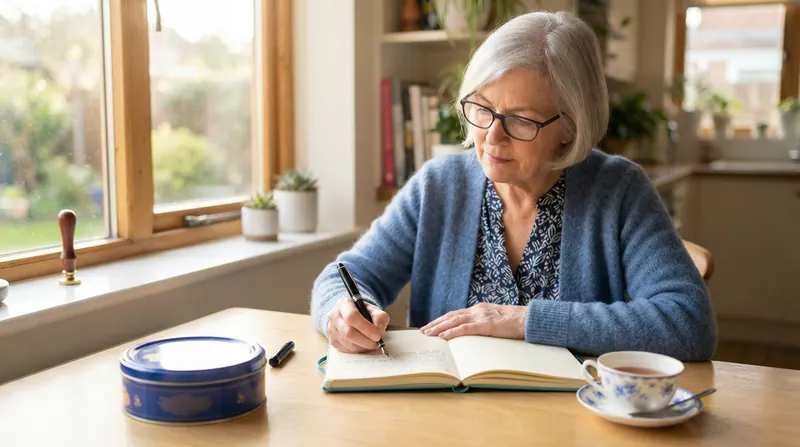
On the first page, in the top margin, I wrote the title in my best clerk's hand: The Balance Journal.
I chose the word carefully. Not the "sugar" journal, not the "health" journal.
Balance, the way a town budget balances: what comes in, what goes out, what you can account for.
And underneath, the rule I used to write at the top of every first draft of minutes: record what happened, not what you wish had happened.
I set up the columns that first evening. Date.
Time of the four o'clock click. What I reached for.
How many. Whether I walked after supper.
How far.
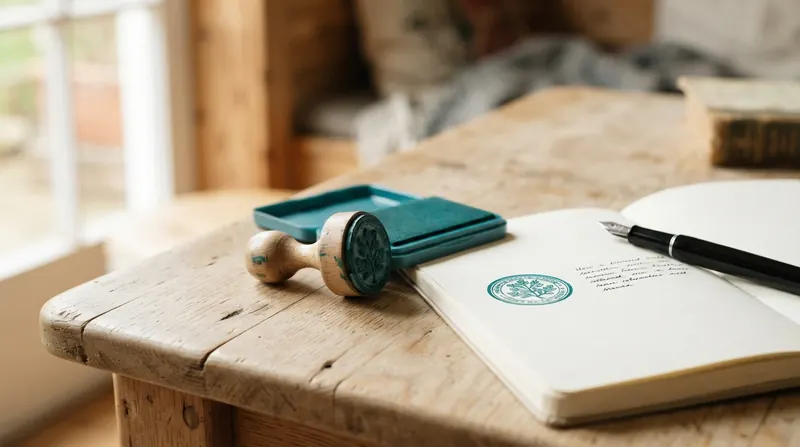
I bought a rubber stamp too, a round one, from the same stationery store. They make them to order.
Mine says "steeped & recorded" around the edge, though I did not know yet why I would need the word "steeped."
At the time I just liked the shape. It looked like the town seal.
It looked like a page was finished.
What the Tin Actually Gave Up in Two Weeks
I kept the columns for two weeks before I changed a single thing, because that is how you do it with a budget. You do not cut a line until you know what the line is.
The cookies were not "one or two."
In fourteen afternoons, the tin gave up fifty-one cookies. I counted them the way I used to count ballots, with a tally mark for each and a slash through every fifth.
That is between three and four an afternoon. Some days two.
One rainy Thursday, seven, which I recorded with the same flat ink as the others because the minutes do not editorialize.
The walks after supper were worse. Five out of fourteen evenings.
The other nine, I had a reason, and I wrote each reason down, and reading them back I would not have accepted a single one from a councilman.
I want to stop here and say something to anyone reading this with their own tin in the cupboard.
The tally was not a judgment. It was a record. The point of a minute book is not to shame the council.
The point is that nobody can argue with what's written down.
When I brought that page to my clinician later, she did not care about the number fifty-one. She cared that I had a page at all.
Two Laps Around the Gazebo, Counted Like Ballots
The walk my clinician asked for has an obvious route in Haddon Mills. You leave Main Street at the bank, cross to the town green, and go once around the gazebo on the paved loop.
One lap is about a third of a mile. Lowell measured it in 1997 with a wheel he borrowed from the highway department, and he was never wrong about a distance.
In those first two weeks, the five walks I did manage were one lap each. I came home, sat on the porch step and wrote "1 lap" in the column.
I want to record this honestly too. The walks were not hard. They were just easy to skip.
A clerk can tell the difference between a motion that fails and a motion nobody brings to the floor.
The green at suppertime has its regulars. The Kowalski brothers on the bench by the war memorial, the young mother with twins in a double stroller, the man who walks a very old beagle at the beagle's pace.
None of them knew I was keeping minutes. All of them, I realize now, were part of the record.
You show up for people who expect to see you.
By the end of the second week I had decided that the walks would get their own line in the journal, with a box to tick, the way the council's attendance used to get a tick beside each name.
Everything I Tried Before the Box Arrived
A clerk knows that the first motion is rarely the one that passes. So I tried things, and I recorded them, and most of them failed in an orderly fashion.
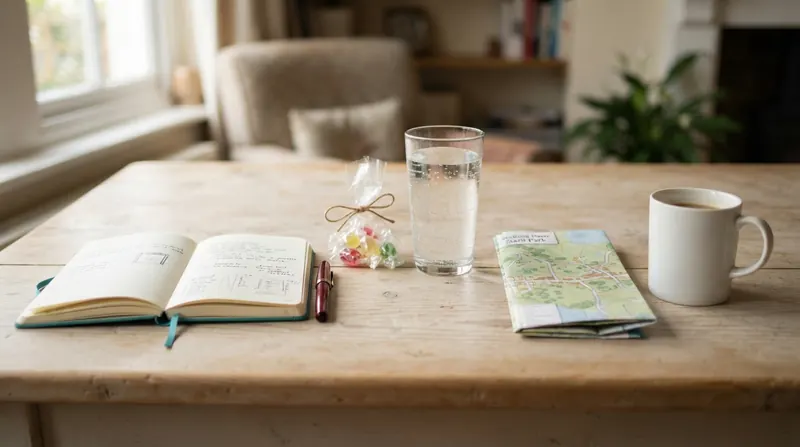
Motion one: hide the tin. I put it on the top shelf above the refrigerator.
By the third afternoon I had learned that I am still able to use a step stool.
Motion two: sugar-free hard candies. A bag from the candy aisle at the grocery.
They tasted like a dentist's office, and I ate the whole bag in six days, which the journal recorded without comment.
Motion three: a glass of water at four. Sensible.
Recommended by everybody.
It did nothing for the part of me that wanted to sit down and hold something warm.
Motion four: the walk at four instead of after supper. It worked on dry days.
Ohio in March has very few dry days.
Motion five: coffee. It filled the slot, and then it filled my evening with jitters and a two a.m. ceiling, so I withdrew the motion before it could be seconded.
Reading those pages back, I noticed the pattern a clerk would notice. Everything that failed was trying to take the four o'clock away from me.
And everything that came close was trying to give me something to do with it. A walk.
A warm cup. Something with a beginning, a middle and an end.
I wrote that in the margin, in red ink, which I reserve for things I want to find again: *Don't cancel the meeting. Change the agenda.*
Saroja, Who Hemmed Half the Town's Trousers
For twenty-six years, the building to the left of the Haddon Mills town hall was Menon Alterations, a narrow storefront with a dress form in the window and a bell over the door.
Saroja Menon ran it. She hemmed the council's trousers before every Memorial Day parade, let out the mayor's jacket twice, and took in my own wedding dress for my daughter in 2006.
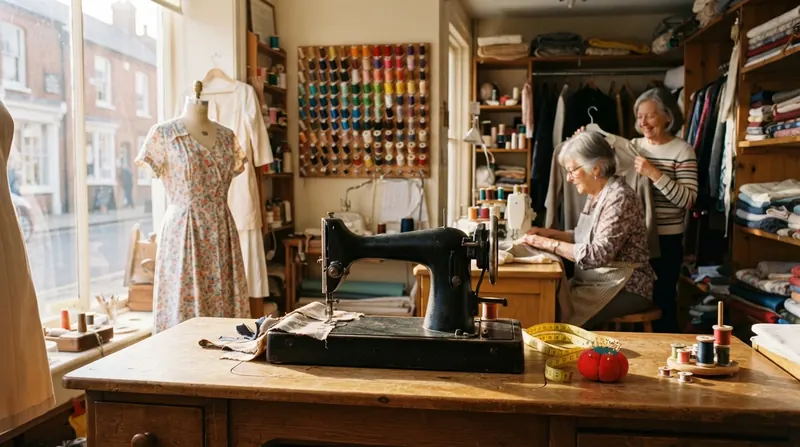
Saroja is seventy-six. She grew up in Kerala, in the south of India, and came to Ohio in 1979 with her husband, a mill engineer, and a single suitcase of fabric.
On meeting nights, when the council ran late, she would bring a thermos of tea to the clerk's office and leave it on my desk without a word. Thirty years of that.
She closed the shop in 2017. We have had lunch every other Wednesday since, at the diner across from the old shop, in the same booth by the window.
I did not tell her about the journal. A clerk does not discuss a record that is still open.
But at our Wednesday lunch in early April, I passed on the pie. I had never once passed on the pie.
Saroja put down her fork and looked at me the way she used to look at a hem that wasn't straight.
So I told her. The clinic, the turned screen, the tally, the fifty-one cookies, the failed motions.
She listened to the whole thing without interrupting, which is a seamstress's gift. Then she said something I wrote in the journal that evening, word for word.
What Saroja's Grandmother Was Laughing About
On Friday, Saroja came to my door with a small green-and-black box under her arm and a story she had clearly been rehearsing in the car.
In the village where she grew up, her grandmother kept a climbing vine against the stone wall of the well, with small, oval, dark green leaves.
The children were dared to chew a single leaf, and then their grandmother would hand them a spoonful of sugar from the kitchen tin.
"It tasted like sand," Saroja said. "Like wet sand.
You could feel it on your tongue, but the sweet was gone. We screamed.
She laughed until she had to sit down."
The effect lasted a little while, she said, and then the sweetness came back, and the children ran off to find another dare.
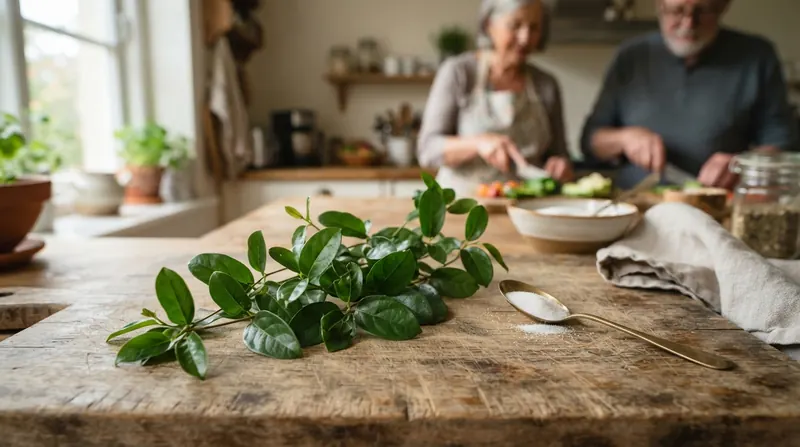
I am a clerk. I do not take a story into the record without a source.
So that evening, I looked the plant up.
The vine is Gymnema sylvestre, a woody climber native to the forests of central and southern India. In the old Ayurvedic tradition, it goes by the Sanskrit name gurmar.
That name is usually translated with a bold phrase about sugar that I will not copy into this journal, because a nickname is not a finding.
But the fact behind the nickname is a plain, checkable one, and it is about taste. Chewing the leaf temporarily dulls the perception of sweetness, an effect attributed to compounds in the leaf called gymnemic acids that sit on the tongue's sweet receptors.
That is exactly what Saroja's grandmother was laughing about. Sugar on a gymnema tongue tastes, for a little while, like sand.
I wrote the source down. I underlined the word *temporarily*.
And I underlined *perception*, because that word is about the tongue and nothing further down.
Eighteen Bags, One Leaf, a Carlsbad Address
The box Saroja brought is Buddha Teas Gymnema Tea. It is about the size of a paperback novel, with a black lower half, a green upper band, and a round gold seal of a seated figure.
The front says, in small letters: "Ancient Ayurvedic Herb for Balanced Wellness." That is the only sentence on the front, and it makes no promise I can hold anyone to.
"Why this one?" I asked her, because in the clerk's office you always ask why this vendor.
Saroja had three answers, and she ticked them off on her fingers the way she used to count pins.
"One. It's only the leaf.
Nothing mixed in, nothing to argue with. Two.
The bags have no plastic, and I don't want plastic in hot water at my age."
"Three. There's a real street address on the back, in California, and a telephone number.
I called it once about an order of their ginger tea. A person answered."
I could have hugged her. A street address, a telephone number and a single ingredient.
That is the town clerk's entire checklist for any vendor who has ever stood at a council podium.
Before I opened it, I did what I would have done with any document handed to me at a meeting. I turned it over and read the back panel, every line, out loud, at the kitchen table.
The Label, Read Into the Record
I am going to give you the back panel the way I would read an item into the minutes: what it says first, and then the clerk's note.
Ingredients: Organic Gymnema Leaf. Three words.
In thirty-one years of reading proposals, I learned that the shorter the list, the fewer places there are to hide something.
Clerk's note: single ingredient, confirmed.
Nutrition Facts, not Supplement Facts. This one surprised me.
The panel is the same black-bordered box you see on a can of soup.
The tea is packaged and labeled as a food, an herbal tea. Clerk's note: it is sold as a cup to drink, not as a dose.
Serving size: one tea bag, 1.3 grams. That is about a quarter of a teaspoon of dried, cut leaf.
Clerk's note: the box does not say how much of the leaf's own compounds are in that 1.3 grams, and I will not guess.
Calories 0. Total carbohydrate 0 g. Not a significant source of total sugars or added sugars. For a woman counting what goes into a four o'clock, this line matters.
The cup itself adds nothing to the tally.
Clerk's note: zero, as printed.
Directions: Fresh water is essential. Use one tea bag per cup of boiling water. Cover and steep for 3 to 6 minutes. The listing adds a water temperature of 205 degrees Fahrenheit, which is just off the boil, and says any time of day.
Clerk's note: the word *cover* is doing quiet work.
More on that later.
The caution, in plain words. The box tells anyone who is pregnant or nursing, anyone taking something their clinician manages, and anyone living with a health condition to talk with a healthcare provider before using it.
Clerk's note: I fall in the last group, and so I did exactly that, and I will tell you how.
Certified Organic by CCOF, USDA Organic, Certified Kosher, compostable plastic-free bags, a 100 percent recycled and recyclable carton, no artificial flavors, colors or preservatives. Clerk's note: every one of these is a statement about how the leaf is grown and packed.
None of them is a statement about what the cup does.
Living Wellness Partners, LLC, 3305 Tyler Street, Carlsbad, CA 92008. Clerk's note: a legal name, a street number and a ZIP code, printed where anybody can see it.
The listing adds a telephone line, (800) 642-3754, described as open around the clock, and an email, [email protected].
I closed the reading the way I used to close an agenda item. Motion to accept the label as read. Seconded by Saroja. Carried.
A short label is not a promise. It is just a short list of things you can check.
Asking My Own Clinic Before the First Cup
The box said to ask a healthcare provider first, so I did not open it that Friday. I put it on the windowsill next to the brass seal press, and on Monday morning I called the clinic.
I asked for the clinic's advice line and read the back panel to the woman who answered, every line, the same way I had read it to Saroja.
She asked what else I take every day, and I read her that list too. She asked me to hold, and came back a few minutes later.
What she said, I wrote down: that a cup of herbal tea in the afternoon was a reasonable thing to discuss, that I should keep doing what my clinician had asked, and that I should bring the box and the journal to my next visit so they could look at both.
She did not say it would help. She did not say it would not.
She said bring the box. A clerk respects a person who asks for the document.
I want to underline this for anyone with a box of anything on their own windowsill. The order is: read the label, call your own clinic, then decide.
Not the other way around.
And a tea, any tea, goes next to whatever your clinician has asked of you. Never in place of it.
I would not let a vendor rewrite the town budget, and I will not let a tea box rewrite my care plan.
What the Research Says, Read Like a Variance Request
In the clerk's office, when a resident asked for a zoning variance, the council always wanted the same thing: the evidence, the size of it, and what it did not cover.
So I went to the library and asked the reference desk for the research on gymnema. Our librarian, who has helped me find things since 1983, found the most recent summary within the hour.
I read it three times, the way I read anything that comes with numbers. Here is what I would have put in the minutes.
What was studied. Ten clinical studies, pooled together, with 419 people in all.
Not 419 people in one study.
Ten groups, averaging about forty people each. [1]
What they found. Across those studies, taking gymnema was associated with lower fasting and after-meal glucose readings, along with lower triglycerides and other blood fats. [1]
What the authors said about it themselves. That the studies were small, and that they were heterogeneous, which is a long word meaning they did not all do the same thing in the same way. [1]
Now the clerk's notes, and these are the part I care about most.
Clerk's note one: "associated with" is not "caused." It means that when the numbers were added up, they leaned one way.
It is the language of a careful study, and I am keeping it careful.
Clerk's note two: the studies tested gymnema supplementation, not a cup of this tea. The amounts and forms in those studies are not printed on my box, and the box does not say how much of the leaf's compounds end up in one cup.
I cannot connect the two, and neither can you.
Clerk's note three: small and heterogeneous. Four hundred nineteen people is a town meeting, not a census.
The authors said so.
That is why I trust them.
Clerk's note four: none of this is about me. My numbers are my clinician's business, read on her screen, at her desk, with her training.
Not mine at the kitchen table with a cup in my hand.
So the research goes into this journal as what it is: a file worth knowing about, honestly sized, and not a reason to expect anything from a cup.
If that sounds like a let-down, I understand. But I spent thirty-one years watching people promise the council things that a small study did not say, and the minutes were never kind to them.

What This Tea Is, and Everything It Is Not
Before the first cup, I wrote two lists in the journal, one on each facing page, because that is how you prepare for a council vote. What the thing is.
What the thing is not.
What it is. A dried, cut leaf from a climbing vine, packed in a paper bag, steeped in hot water, and drunk from a cup.
That is the whole of it.
It is a single plant. It is caffeine-free.
It has zero calories and zero carbohydrate on its own, as the panel prints. It is organic, kosher and packed in a bag that goes in the compost when you're done.
It is, according to the listing, woody and grounding to the taste. To my tongue it is more like a strong green tea with the bitterness turned down and something faintly like dry hay underneath.
Saroja says it tastes like her grandmother's well.
What it is not. It is not something you swallow whole with a glass of water.
It is not an extract in a little glass bottle, and it is not a powder you stir in.
It is a cup of tea.
It is not a sweetener, and it does not make a cookie disappear from the tin. Only my hand does that.
It is not a replacement for anything my clinician has asked me to do. The walk after supper stays.
The regular meals stay. The next visit stays on the calendar.
It is not a reading. It does not appear on any screen.
It is a thing I drink at four o'clock while the house is quiet.
And it is not a promise. Nobody at Buddha Teas has promised me anything personally, and the box does not either, beyond "balanced wellness," which is a phrase for a feeling and not a number.
Boiling Water, a Saucer for a Lid, and Five Minutes
The first cup was on a Tuesday, at four o'clock, on the click.
I filled the kettle with filtered water from the pitcher in the refrigerator, because the box insists fresh water is essential, and I am not about to argue with a back panel on day one.
I used my mother's white porcelain cup, the thin one with the gold rim. The box recommends glass, ceramic or stainless steel, and porcelain is close enough for the minutes.
When the kettle began to whistle, I let it settle for a few seconds, because the listing says 205 degrees and that is just off the boil.
I dropped in one bag. And then I did the thing the box asks that I had never done with a cup of tea in my life: I covered it.
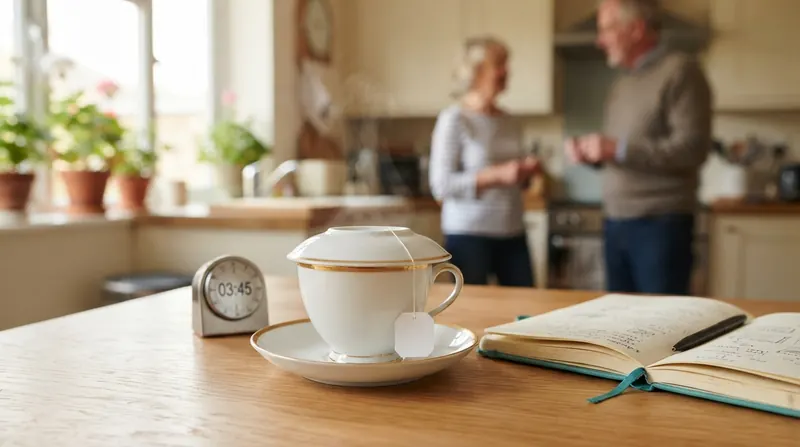
A saucer, turned upside down, set on top of the cup. Saroja says her grandmother used a brass plate.
Covering the cup keeps the steam and the warmth in while the leaf steeps. It also means you cannot see the tea, which turns out to matter more than you might think.
Because for five minutes, there is nothing to look at. There is a covered cup, a ticking kitchen timer, and a woman sitting at a table with her hands in her lap.
For five minutes, the four o'clock has an agenda. Call to order, kettle.
Old business, the bag.
New business, the saucer. The timer is the chair.
When the timer went off, I lifted the saucer. The tea was a clear gold-green, a little cloudy at the bottom.
It smelled like a hayfield after rain.
I drank it slowly, the way you drink something you have waited five minutes for. It took about twelve minutes, all told, from the click to the empty cup.

And then I opened the journal, wrote the date, wrote "one cup, five minutes, covered," and pressed the round stamp at the bottom of the page.
Steeped & recorded. That was why I had bought the stamp.
I just hadn't known it yet.
What a Clerk Does While a Cup Is Covered
People ask me what I do for the five minutes while the saucer is on the cup. The honest answer is that I read the old minutes.
When I retired, the council let me keep my personal carbon copies of the first drafts, the ones in fountain pen before they were typed. There are eleven boxes of them in the spare room.
So at four o'clock, with the timer running, I take out one meeting. Any meeting.
The night in 1991 when the library roof was approved. The night in 2003 when the fire siren schedule nearly started a feud.
I read the first page, and when the timer goes off I stop, mid-sentence if I have to, and lift the saucer.
It sounds silly. But the five minutes have become the part of the day when I hear the town again: Mr. Dorsey and his pump, Mrs. Ochs and her traffic, Lowell in the third row of the public seats, every first Tuesday, pretending he came for the zoning.
The cup is the reason I sit down. The minutes are the reason I stay seated. Five minutes is not long.
It is long enough to be somewhere else for a while.
Saroja says her grandmother sang while the plate was on the cup. I do not sing.
I read. The agenda for the four o'clock is whatever you bring to it.
What Happened to the Cookie, Recorded Without Adjectives
I promised you I would record what happened, not what I wished had happened. So here is the cookie, as entered.
On the first afternoon, after the cup, I opened the tin and ate one butter cookie, out of what I can only call professional curiosity.
It tasted a little flat. Not like sand, the way Saroja's grandmother's fresh leaf did.
More like a cookie that had been left out on the counter since yesterday. I ate one, and closed the tin.
On the third afternoon, the cookie tasted exactly like a cookie. I ate two.
On the sixth afternoon, I forgot to open the tin at all, and noticed only at supper, and wrote it down with the same flat ink as the others.
I want to be very careful here, the way the minutes are careful. I cannot tell you the tea did anything to my appetite.
I can tell you that a covered cup took up the time the tin used to take up, and that my tongue sometimes found the cookie less interesting after it.
One tongue, one kitchen, one journal. That is not a study.
Saroja's grandmother would have called it a dare.
The tin is still in the cupboard. It still has cookies in it.
The difference is that it no longer opens itself at four o'clock. I open it, on purpose, when I decide to, and I write it down.
A New Product, and Nobody's Review Yet
In the clerk's office, before the council voted on a vendor, I always pulled the file of complaints and compliments. So I went looking for the reviews.
There were none. Not bad ones, not good ones.
The Gymnema Tea is new on the seller's site, and as of October 25, 2026, its page has no customer reviews at all.
I want to be honest about what that means, because a lot of pages would fill that silence with something. An empty review page means nobody has written one yet.
It does not mean the tea is good, and it does not mean it is bad.
I will not borrow reviews from the company's other teas and pretend they are about this one. That would be like reading the minutes of the Elmwood council into the Haddon Mills record because the towns are next to each other.
So in place of reviews, here is what a clerk can actually verify about the seller, line by line, and you can verify every bit of it yourself.
I have seen vendors at council meetings who could not give me a street address. I have seen vendors whose phone number went to a voicemail box that was always full.
A company that prints its address on every box, and lists a phone line that is open at three in the morning, is a company that expects to be found. That is not proof of anything about a leaf.
It is proof of where to send the letter.
I wrote the phone number on the inside cover of the journal, under the town hall's old number, which I still know by heart. I have not needed to call it.
I like knowing that I could.
What the Seller's Page Says, and What I Left Out
A clerk reads the whole file, including the parts she won't use. So I read the seller's online listing for the tea from top to bottom, twice.
It describes the taste as grounding and woody. It calls the tea a single-ingredient Ayurvedic ritual in bleach-free, plastic-free bags.
It files the tea under a store category called Energy & Metabolism.
It also carries a short list of benefit lines about sugar and metabolism, and it uses the loose translation of the old Sanskrit name in quotation marks.
I have not copied any of those benefit lines into this journal. Not because I think the company is dishonest.
Because a list of benefits on a product page is not a study, and the study I could find was about supplements, not this cup.
In the minutes, when a vendor said something the council could not check, we recorded it as "the vendor stated" and moved on. That is the most I can do with a benefit line: note that it exists, and leave it out of the facts.
The store's pages also carry the familiar sentence that its statements have not been evaluated by the Food and Drug Administration. I read that sentence the way I used to read a signature line.
It is the part that tells you who is responsible for what.
The listing also shows a review average for the store as a whole. This particular tea had no reviews of its own yet, so I counted both and filed them separately.
Why Saroja Cared About the Paper More Than the Leaf
Saroja's second reason, if you remember, was the bag. I did not understand at first why a seamstress would care so much about a tea bag.
"Marjorie," she said, "I spent forty years with fabric. I know what is woven and what is melted.
Some tea bags are melted."
She meant plastic. A good many tea bags on the grocery shelf use some plastic to hold their shape or seal their edges, and the hot water goes right through them.
The Buddha Teas bags are listed as plastic-free and bleach-free, and the back of the box calls them compostable. The carton itself is listed as 100 percent recycled and recyclable.
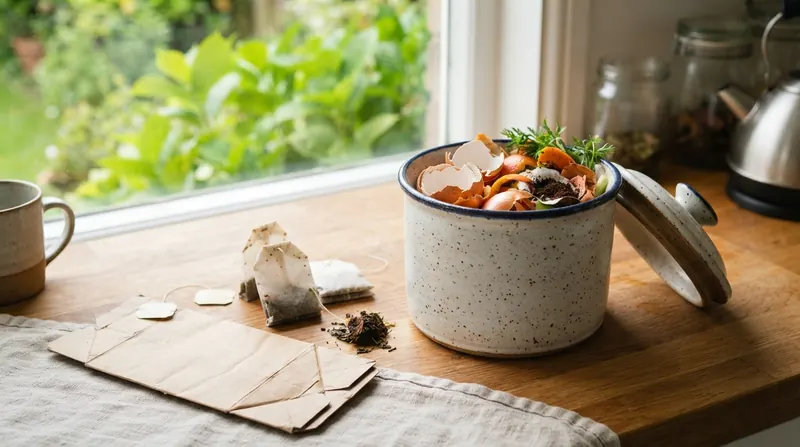
I keep a compost crock by the sink for the garden. The used bags go in it every evening, and the box went into the recycling when it was empty.
I am not going to tell you a plastic-free bag does anything for your numbers. It doesn't, as far as anyone has told me.
It is a statement about the bag, not about you.
But a woman who is drinking a cup every afternoon for months would rather the hot water go through paper. Saroja was right about that, the way she was right about every hem.
What the Cup Costs, Counted to the Penny
A town clerk also keeps an eye on the money, so of course I counted that too.
One box is $7.95 at the seller's listed price. Eighteen bags.
That is about 44 cents a cup.
The store also lists volume pricing across its teas: five percent off when you buy six or more boxes, which brings a box to about $7.56, and ten percent off plus free shipping at ten or more, about $7.16 a box.
I buy one box at a time. At one cup a day, a box lasts eighteen days, and I would rather check in with the journal each time I reorder than commit to a cupboard full.
For comparison, the clerk in me added up what the tin used to cost. A tin of the grocery's butter cookies is a few dollars, and at three or four a day it lasted me about a week and a half.
I am not going to pretend the tea saves money. The two cost about the same.
The difference is not in the price. The difference is in what I'm writing down.
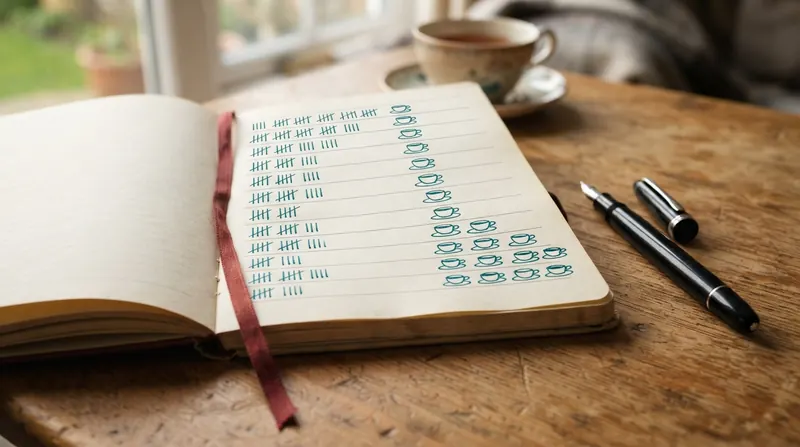
Six Weeks of Afternoons, Entered Exactly as Written
Here is the journal itself. I have copied it out, week by week, without polishing it, because polished minutes are a lie of a particular kind.
It records cups and cookies and walks. It does not record any reading, and it never will in a public column.
Those belong on my clinician's screen.
The balance journal, April to May
- Week 1Six cups out of seven afternoons, all covered, all five minutes. The tin opened four times. Walked after supper three evenings. Noted: the covered saucer makes the kitchen smell like a hayfield.
- Week 2Nothing much to report, and I reported that. Five cups. The tin opened five times, two cookies twice. Rain all week, one walk. Wrote "the cup does not change the weather" in the margin.
- Week 3Seven cups. Saroja came for a cup on Thursday and we covered two cups with two saucers and timed them together. The tin opened three times. Four walks.
- Week 4Six cups. Forgot the tin entirely on two afternoons. Walked to the town green and did two laps around the gazebo before supper four evenings out of seven.
- Week 5A bad week: a funeral on Tuesday and a long Sunday. Three cups. The tin opened six times and I wrote each one down. A record with a bad week in it is still a record.
- Week 6Back to six cups. The tin opened twice. The walks are now three laps of the green, five evenings. Ordered a second box, by myself, on the computer, which Saroja insists I record as a milestone.
Kettle on? I closed the shop early. Nobody needs a hem on a Thursday.
3:41Kettle on. Two cups, two saucers, one timer.
3:43Bring the timer to the table this time. Last week it rang in the hallway.
3:44Noted for the minutes. Door is open.
3:45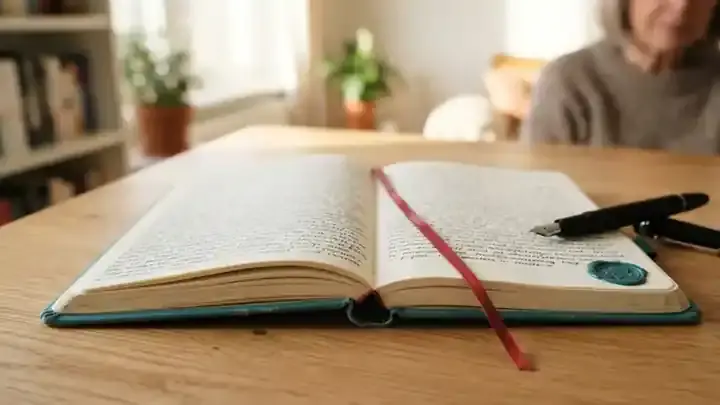
I want to point out week two and week five, because those are the weeks a polished page would leave out.
Week two, nothing happened. The rain kept me in, the cup was pleasant and the tin opened anyway.
I wrote that down plainly.
A minute book with only good meetings in it is a book nobody should trust.
Week five, life happened. A friend from the church choir passed, and I spent two afternoons at the funeral home and the reception hall, where the cookies were on a long table and I did not keep count.
I did write them down afterward, as best I could remember, with a note: "estimate, not exact." That is how a clerk records a vote she missed.
And the walks. I did not expect the walks to be the line that changed most, but they were.
Not because of the tea. Because of the timer.
Five minutes of sitting with a covered cup, it turns out, is about the right amount of time to decide that you are going to walk after supper. By the time the saucer comes off, the decision has been seconded.

Ordering by Myself, and Checking the Shipment Against the Record
In week six I ordered the second box myself, on the computer in the spare room, with my reading glasses on and the journal open beside the keyboard.
The order page asked for the usual things. I chose one box, read the total, and wrote the order number in the journal before I clicked, the way I used to write a resolution number before a vote.
When the box arrived, I did what a clerk does with any delivery to the town hall. I checked it against the record.
Same green band, same round gold seal, same back panel, same three-word ingredient list, same eighteen bags. I counted them.
Eighteen.
I pressed the round stamp on the page and wrote "received, checked, complete." Saroja says I am the only person in Ohio who audits a box of tea.
She may be right.
But I would rather be the person who checks than the person who assumes. The box is small and the price is small.
The habit of checking is the only thing in this story that I am sure is worth the money.
Ordered the second box of tea myself tonight. Wrote the order number down first.
6:12Mom! Without calling me? Who are you?
6:20A woman with reading glasses and a journal. It arrives Friday.
6:22Save me a cup for Sunday. I want to see this famous saucer.
6:23What I Brought to the Clinic in My Handbag
In September I went back to the clinic for the follow-up. I brought the journal, the box and the label, the way the advice line had asked.
My clinician turned the pages slowly. She read the tally pages and the walk columns.
She asked about week five, and I told her about the funeral.
She read the back of the box and handed it back. She said that what goes in my afternoon cup is something we can keep talking about at each visit, alongside everything we had already planned.
What she said about my numbers is between her and me, and it belongs on her screen, not in this column. I will not print it here, good or bad, because a reader might take it as a promise for herself.
What I will print is the thing she said that I wrote down in the parking lot, word for word, because it is the most useful sentence in this whole journal.
Keep it. So I kept it.
I am on my third journal now, the same teal cover, the same brass clasp, and the round stamp is wearing smooth at the edges.
What the Library Corkboard Said
In June, the library asked whether I would pin a copy of one journal page to the community corkboard for its "Notes from Home" exhibit. I chose the page with the six-week tally.
The same week, the Tuesday quilt guild at the library noticed the blue tin was missing from the side table.
Marjorie, is the blue tin coming today? It has been at every meeting since 2011.
9:02The tin is retired to the top shelf. I'm bringing a thermos and the good cups.
9:10Fine, but somebody tell Bev to bring her lemon bars.
9:11Already in the oven. Save me a seat by the window.
9:14People wrote back on index cards and pinned them underneath. The comments below are illustrative, retold as composites with the names shortened, and they appear here because they ask what you are probably asking.
I answered every card I could in my own hand and pinned the answers back up. The librarian says it was the most-read board of the summer, which in Haddon Mills is not a large competition.
Two Old Friends in the Library's Oral-History Booth
In August, the Haddon Mills library started an oral-history project, recording longtime residents in a little booth they built out of the old periodicals closet.
They asked Saroja and me to sit down together for a segment about the town hall and the shop next door. We talked for forty minutes.
Somewhere in the middle, we talked about the tea.
Here is that part, transcribed and lightly edited. It is a dramatization of our conversation, retold with Saroja's blessing.

Voices of the Mills · Segment 14
The Clerk and the Seamstress Talk About Four O'Clock
Marjorie
host
Saroja, the librarian wants the story of the box. You tell it better than I do.
 Saroja
guest
There's not much story. You stopped eating pie at the diner, and I thought, she is worried and she is counting, and Marjorie counting is a serious thing. So I brought her a cup to sit down with.
Marjorie
host
And the vine by the well. Tell them about the sugar.
Saroja
guest
My grandmother made us chew one leaf, then gave us a spoon of sugar, and it tasted like sand. Only for a little while. We screamed, she laughed. That's all the leaf ever promised me: a funny tongue for a few minutes.
Marjorie
host
That's what I wrote down, too. A fact about taste. I wouldn't write any more than that, and the research I read didn't let me.
Saroja
guest
That's why I trust your book. You wrote down the bad week. You wrote down the funeral and the cookies on the long table. Nobody who is selling something writes down the funeral.
Marjorie
host
I'm not selling anything. I'm keeping minutes. What did you like about this one, really? You could have brought me any tea.
Saroja
guest
Three things. Only the leaf, nothing mixed. No plastic in the bag. And a real address in California and a phone that a person answers. At our age, you want to know where to send the letter.
Marjorie
host
And the saucer on top. I'd never covered a cup of tea in seventy-three years.
Saroja
guest
That's the best part, and it's on the box. Five minutes with nothing to look at. You sit. You stop. Now you sit at four o'clock instead of eating at four o'clock. That's the whole thing, Marjorie. You did it, not the leaf.
Marjorie
host
Let the record show that the witness gives the credit to the clerk. Motion to adjourn?
Saroja
guest
Seconded. And the timer just went off, so the tea is ready.
$7.95 for 18 cups · read the current terms on the seller's page
Thirty Days, With One Line Most Pages Skip
A clerk does not file a purchase without reading the return policy, so I read Buddha Teas' policy the same way I read the box.
The store's policy gives you 30 days to return a purchase. That is the headline, and it is true as far as it goes.
But there is a second line, and I am printing it as plainly as the first: opened food items are not returnable. Tea is food.
Once you open the box and use a bag, that box is yours.
I want you to know that before you order, not after. A great many pages would print "30 days" in a big gold seal and leave the second line for you to discover.
I would not have let a vendor do that at a council meeting.
So here is how I would think about it, as a clerk. The 30 days protects you from a damaged or wrong shipment, and from a box you change your mind about before opening.
It does not refund a box you tried and didn't care for.
At $7.95 a box, I decided that was a risk I could carry. One box is eighteen days of afternoons, and the journal would tell me within a week whether the covered cup was a habit I wanted to keep.
If you have a question about an order, the phone line is the place to start. I have read their policy; I have not tested it, and I will not pretend I have.
Who the Cup Might Suit, and Who Should Skip It
In my last year as clerk, the council asked me to write a one-page summary at the top of every long agenda item, so they could see the point before the details. Here is mine.
- You have a time of day, like my four o'clock, that you'd rather sit down with than eat through
- You want a single ingredient you can read in three words, with no caffeine and zero calories as printed
- You like a plastic-free bag that goes in the compost, from a seller with a printed street address and a phone line
- You'll keep some kind of notebook, so the page tells you what the afternoon looks like
- You've already asked your own clinic about adding an herbal tea, with the box in hand
- You are looking for something to take the place of what your clinician has asked you to do; nothing in a teacup does that
- You want a promise about your numbers; nobody honest can make one, and this journal won't
- You are pregnant or nursing, or living with a health condition, and haven't talked with your healthcare provider yet; the box itself asks you to
- You expect a cookie to taste like sand every time; that was a fresh leaf on a child's tongue, not a cup of tea
- You need a refund after trying it; opened tea is not returnable under the store's policy
If you land on the first list, the box is small and the price is small. If you land on the second, please put the money toward a good notebook instead.
I mean that.
Questions Over Pie, Answered From the Box
Once word got around that Marjorie Pell was drinking a covered cup at four o'clock, the Wednesday lunches at the diner started to include questions. Here are the ones I can answer from the box and the listing.
Can I put honey in it? You can put anything in your own cup.
But the box's zero calories and zero carbohydrate are for the bag in plain water. A spoon of honey goes in the tally on its own line.
Can I use two bags for a stronger cup? The box says one bag per cup.
Five minutes covered makes it plenty strong for me, and six makes it stronger than I like.
Morning or afternoon? The listing says any time of day, and with no caffeine it will not keep you up.
I drink mine at four because four is when I needed it.
How long does a box last? Eighteen bags, eighteen cups.
At one a day that is about two and a half weeks. I write the reorder date in the journal on day twelve.
Is it the same as chewing the fresh leaf? No.
Saroja is clear on this. A steeped cup of dried leaf is not a fresh leaf from the vine by the well, and I have never had a sand-flavored cookie from it.
Should I ask my own clinic first? Yes.
The box asks you to if you are pregnant or nursing, taking anything your clinician manages, or living with a health condition. I would ask regardless, with the box in your hand.
What a Box Costs Against What It Asks of You
Here is the arithmetic again, because I would never let the council vote without it in front of them.
A box asks very little of you: a kettle, a cup, a saucer and five minutes. It asks you to read the back panel and to call your own clinic first.
What it gives you, as far as I can honestly record, is a warm cup with no calories, one leaf with a long history and a small file of research, and an agenda for the quietest part of your day.
That is all I can enter into the record. For me, it was enough to keep a box on the windowsill next to the brass seal press.
One box, 18 afternoons · current price and stock on the seller's page
P.S. The tin is still in my cupboard, and it still has cookies in it. What changed is that the four o'clock click now means the kettle, the saucer and the timer, and the tin opens when I decide to open it. The cup did not do that. The journal did, and the cup gave it five minutes to work.
P.P.S. Whatever you decide about the tea, buy the notebook. Write down your afternoons for two weeks before you change a single thing, and bring the page to your next visit. Your clinician will thank you for it, and so will the clerk in you.
The leaf, line by line — what gymnema is, what its Sanskrit name gurmar refers to, what the 2021 review pooled and did not cover, and why a cup of tea is a different thing from the forms that were studied — is written out in the ingredient and advertising guide linked at the foot of this page.
The guide also covers the back panel's caution, the return terms worth reading twice, and which advertising headlines about this leaf deserve your skepticism.